


Cyberpunk 2025: Listen all y'all
Part 12: Elysium and How to Blow Up a Pipeline


From about the end of the Renaissance on, there was a certain kind of shoe associated with the working class in mainland Europe. The style varied from fully wooden clogs, like every Dutch person still wears (citation needed), to leather shoes with a wooden sole. They were the work boots of the time and worn by the people who ended up operating the machines of the Industrial Revolution.
The Industrial Revolution was great for productivity, but terrible for labor. With the shift from agrarian to industrial production, and the new reliance on machines, workers became replaceable in a way that they had never been before.
Factories were cramped and dirty places. The pay was terrible, the hours were long, and the work was dangerous. The workforce skewed toward children, with their tiny hands that could fit more easily into a factory’s machinery. And there wasn’t a lot a worker could do to protest the conditions — if you complained too much, you could simply be replaced by any of the increasing numbers of unemployed workers.

And that brings us back to those shoes. While it wasn’t possible to speak out against the working conditions or ownership directly, it was still possible to indirectly hurt owners and their pocketbooks by acting clumsily and working slowly — the way one might move when they’re wearing wooden shoes. Those clunky wooden shoes — called sabots — could also (hypothetically and apocryphally) be tossed into the delicate machinery of a factory to break it.
You might call this shoe-ing, or, if you’re French, you could call it sabotage.
Down with all kings but King Ludd
These attacks on machines did not imply any necessary hostility to machinery as such; machinery was just a conveniently exposed target against which an attack could be made.
That quote is from Malcolm I. Thomis, writing about how it wasn’t the machines themselves — the technology — that people had a problem with. It was their loss of agency, their loss of power, and a desire to maintain their livelihoods.

The most famous and best organized of these sabotaging movements is from the textile industry in England during the early 1800s. The economy was in shambles (thanks, Napoleon) and unemployment was high. Factory owners and industrialists were doing everything they could to squeeze out profit while the workers were desperate to keep their jobs. But new machinery meant that fewer, less specialized workers were needed, and that meant, in a time when unions weren’t as popular, competition for those jobs was fierce, and the workers had very little recourse for bargaining.
And, just to be clear, they were bargaining for things like "less child labor” and “machinery that doesn’t kill us.”
There were public demonstrations and letter-writing campaigns. And they built up a folk hero mascot in the mythologized (or maybe fully made up) Ned Ludd. These Luddites, as they called themselves, also started attacking the machinery of factory owners, smashing lace-knitting machines, steam-powered cotton looms, and shearing frames for finishing cloth. And, on occasion, attacking the factory owners themselves.
It was, as Eric Hobsbawn argued, “collective bargaining by riot.”
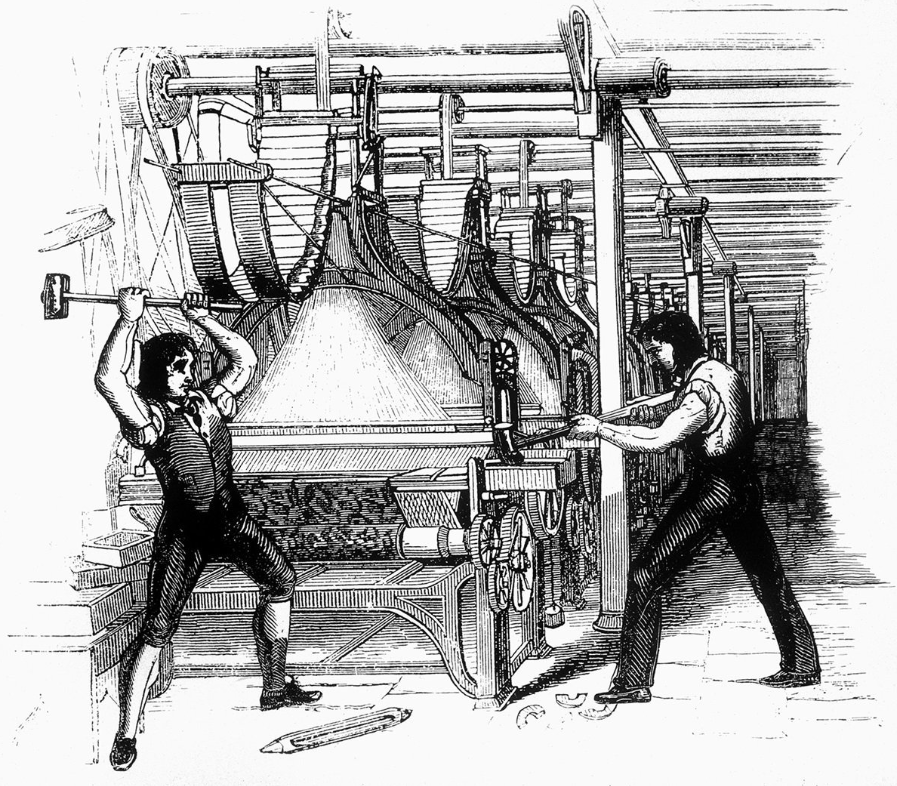
Relations got bad enough that industrialists started building 19th century versions of panic rooms and bunkers or mounting weapons on the walls of their factories. Industrialists were killed. The government responded violently by sending in 12,000 troops. In the end, 30 men were convicted of “machine breaking,” with punishments as severe as execution or, worse yet, being sent to Australia. Machine breaking — industrial sabotage — officially became a capital offense in 1812.
During the Luddite uprising, the middle and upper classes supported the government’s use of troops to during the protests. The lower class — that wooden-shoe shod working class — had become a threat to the status quo and needed to be put down.
Both the Luddites and the concept of sabotage were intrinsically tied to class struggle.
Don’t breathe on me

In 2011, riding high on the success of his first film District 9, Neil Blomkamp started work on his second, Elysium. (We don’t talk about Chappie.)
It is … not as good as District 9 and just a generally not great movie. But it’s fine, and it’s much better than I remembered once you get past Jodie Foster’s indefensible accent (I saw one review describe it as “globetrotting”). The visual effects are outstanding. The vibes are stellar. The worldbuilding is somewhere between good and great. But the script and story just fall a little short. Even Neil Blomkamp said so.

Elysium is a bit more straight sci-fi dystopia than strictly cyberpunk, but if we stick to Bruce Sterling’s definition of “lowlife and high tech,” it’s spot on. It’s got the rich and powerful living on an orbital like Hardwired. It’s got the ex-con living in the overcrowded and dirty city. It’s got storing data in your brain like in Johnny Mnemonic. It’s got cybernetic exoskeletons. It’s got cure-all Med-Bays like in … okay, well, that last one is mostly just QAnon-adjacent psuedoscience conspiracy theories.
The story follows Max “Matt Damon” Da Costa who was raised in an orphanage in the favelas of Los Angeles. (Also, a baby-faced Andor is there?) Growing up, his dream was to become rich enough to buy his way onto the orbiting space station, Elysium, and turned to crime to make his money. Instead of making him rich, it just made him a parolee who could barely hang onto a job in a robot factory.

The inciting incident of Elysium is at that job. In the production process, the robots have to be briefly irradiated (something to do with the paint maybe?). When a door gets jammed, Max’s boss threatens to fire him unless he goes into the radiation chamber to fix it. Predictably, the door locks with Max inside and he immediately receives a lethal dose of radiation.
Max survives, but is promptly fired and given a bottle of pills to keep him upright through his last few days alive. Max uses his remaining time to take revenge on the factory owner and, eventually, on Elysium itself. (I'm going to save the second half of the movie for another entry.)

While Max doesn’t engage in any machine breaking directly — he does shoot a lot of robots — he’s dispossessed, unsafe working conditions led to his death, and he took a factory owner with him.
He’s basically a Luddite.
I see things haven’t changed
In September 2025, President Trump issued National Security Presidential Memorandum (NSPM-7) that expands domestic terrorism to include:
Anti-Americanism, anti-capitalism, and anti-Christianity; support for the overthrow of the United States Government; extremism on migration, race, and gender; and hostility towards those who hold traditional American views on family, religion, and morality.
In May 2026, US Counterterrorism czar Sebastian Gorka released the United States Counterterrorism Strategy. It is a 16 page document filled with propaganda, lies, and sycophancy, but it also lays out who the US government considers “groups that have the intent and capability to plot attacks against Americans.”
It identifies three (and only three?) groups that fit the bill: narcoterrorists, Islamist terrorists, and “violent left-wing extremists, including anarchists and anti-fascists.”
Also in May, Wired reviewed 1,000 pages of unpublished intelligence reports. One report from the New York Intelligence and Counterterrorism Bureau looks to the future.
The chaotic atmosphere that may result from emergent AI technology in the next five years may fuel large-scale protests that devolve into civil unrest and anti-tech violent extremist activity.
Another report from an intelligence group in western Pennsylvania says:
Adversarial actors, including state-sponsored entities, criminal groups, and extremists, such as homegrown violent extremists or environmental extremists, may target US data centers.
All of those definitions are intentionally too broad, but, taken together, they vaguely define a Luddite-shaped target (among many others) — anti-capitalist, anti-tech, anti-authority and anti-fascist, environmental extremists. Because, from the other side, those “extremist” criteria are, in order: pro-worker, pro-worker, anti-fascist (that one’s the same), and anti-climate catastrophe.

Regardless of how useful AI currently is, the technology was cited as the reason behind 50,000 job cuts so far in 2026 — roughly 11,000 jobs per month. The tide is turning on the efficacy of AI for corporations, but the result of its introduction is the same — ownership loves it and immediately used it as an excuse to cut labor. For a lot of people, being anti-AI is just being pro-keeping-my-job.
The rapid, ill-advised, and forced adoption of AI requires a massive number of data centers to support it. There are currently 4,000 in operation across the country (and many, many more proposed). These data centers — especially the new, city-sized ones — require gargantuan amounts of electricity, drain water tables, generate e-waste, and create a life-altering amount of noise pollution. From that perspective, being anti-data center is not being anti-tech. It’s being anti-climate collapse and pro-health.
Framing “anti-tech activism” and “environmental extremism” as domestic terrorism, just like with the Luddites and sabotage, is an act of class warfare.
Two wrong feet and fucking ugly shoes

Earth in Elysium is basically used up. It's polluted, crowded, the air sucks, there's no water, and everyone is sick all the time. That’s why the elites fled to their orbital space station. It’s a common refrain in cyberpunk (and in dystopian fiction in general). Like a lot of aspects of cyberpunk, this is also the result of the genre being born of the 70s and 80s.

In 1969, the Cuyahoga River near Cleveland literally caught on fire — it actually had a century-long habit of doing this. Burning fossil fuels — especially coal — lead to a lot of pollutants in the atmosphere, to the point where the rain was becoming acidic through the 70s and 80s. Chloroflourocarbons, like Freon, used as refrigerants had literally eaten a hole in the ozone layer by the 80s. Hell, we didn’t even officially catch on that putting lead in gasoline might not be a great idea until the 70s.
But it wasn’t that these things happened only in the 70s and 80s. The Cuyahoga had been bursting into flames since the late 1860s. The term "acid rain" was coined in 1872. People were warning about leaded gas in 1924. Global warming as a result of burning fossil fuels was warned about in the 50s. Industrialists just didn’t care.
It is the definition of profits over people.
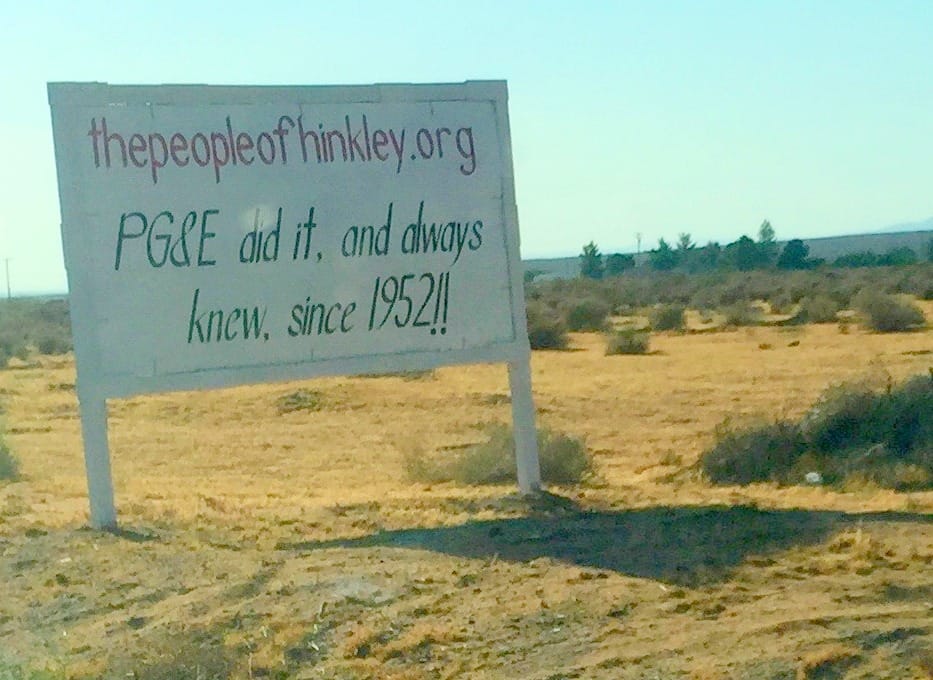
For about 15 years in the 50s and 60s, California utility Pacific Gas & Electric Company dumped 370 million gallons of hexavalent chromium — a carcinogenic chemical used in natural gas distribution — into some unlined holding ponds in the Mojave desert. The unlined part is important because, brace yourself, all of that chromium 6 kind of leaked down into the ground and, from there, into the groundwater.
PG&E let the local water authorities know about it in December of 1987.
About 200 people got cancer as a result of the pollution. The town of Hinkley sued PG&E about it and won. They made a movie about it.
PG&E promised to clean up their mess. A 2013 estimate thought they still had 40 years to go. The plume of chromium 6 in the groundwater started out at about 2 miles long by 1 mile wide. As of 2015, it’s expanded to 8 miles by 2 miles. (PG&E is also, by the way, consistently found criminally liable for their equipment starting wildfires in California.)

The paralegal and activist who helped the town of Hinkley in the 90s — the one they made the movie about — was named Erin Brockovich. She’s spent the decades since participating in other anti-pollution lawsuits, warning about environmental issues, and documenting a lengthy history in the US of profits over people. This year, she launched the Brockovich AI Data Center Reporting website.

Along with lots of useful information on why you might not want a data center in your backyard, it also features a user-generated map of proposed data centers in the US. And while there are plenty in and around population centers like you’d expect, there’re also plenty in rural, less affluent areas.
Last year, a group called the Kapor Foundation examined the distribution of data centers in California (as of late December 2024). At the time, California had the third most data centers in the country. They found that a lot of them were in or near majority-minority communities, and that over 80% were in areas that “already face unhealthy air quality, groundwater threats, and the presence of hazardous waste.”

Elon Musk’s xAI started operations at the Colossus 2 data center along the Mississippi-Tennessee border in South Memphis in late 2025. South Memphis is 75% Black and has a median household income of roughly $30,000 per year. To power the Colossus 2 data center (which, in a display of cringe that only Elon Musk is capable of, apparently has “MACROHARD” painted on the roof), xAI built 27 gas turbines in nearby Southhaven, Mississippi. xAI did not get permits to install the turbines. Those turbines might not even be legal.
The Southern Environmental Law Center and the NAACP are suing about it.
Our communities are not playgrounds for corporations who are chasing profit over people. xAI’s first data center is already creating pollution for Mississippi’s neighbors in Memphis—a community already suffering from decades of disparity—and now they are polluting in Southaven, Mississippi. We will not stand by idly. As we shared when xAI began its operation in Tennessee, this illegal pollution only exacerbates complications to frontline communities who continue to bear the brunt of environmental injustice. We cannot allow for companies to promise a better future while pumping harmful chemicals into the air we breathe. We demand that xAI follow the Clean Air Act and stop operating these unpermitted turbines to protect the people of Southaven.
The press release also points out that Memphis is an asthma capital and both of the involved counties got an F letter grade in ozone pollution from the American Lung Association.
As I hit publish on this article, I saw a new piece from Wired. The United States Department of Justice is now involved in the lawsuit on the side of xAI, saying that not letting Musk use the illegal turbines "directly threatens ongoing national security interests." So that's neat.
That article also points out that there are now 30 more turbines at Colossus 2.
The growth of Colossus 2’s turbines from 27 to 57 means, according to the SELC, that the site has seen a 111 percent increase in nitrogen oxide emissions, a 83 percent increase in PM2.5 emissions, and an 88 percent increase in formaldehyde emissions since April.
xAI plans to open a third data center (named, ugh, “MACROHARDRR”) in Memphis.

Meanwhile, over in Nashville, another AI company named DC Blox is attempting to build a 70,000 square foot data center right next door to the Nashville Zoo.
Beyond their heavy resource consumption, researchers caution that data centers also contribute to noise pollution, light pollution, and threaten water quality in surrounding communities. For the Zoo’s 3,000 animals and a neighborhood already facing economic challenges, this proposed development is especially concerning. Constant noise from cooling systems and generators, and light pollution from bright security and operational lighting can dramatically affect animal behavior, disrupting their natural photo periods and rhythms. Stress on the animals from these factors can be detrimental to our conservation efforts, especially our clouded leopard breeding program. Many cities around the country have shared the negative effects that data centers are causing right now, including our neighbors in Memphis.
Sanitized history
In 1786, the Leeds Mercury newspaper published a letter:
Men of common sense must know, so many machines in use, take the work from the hands employed scribbling. How are these men, thus thrown out of employ to provide for their families; - and what are they to put their children apprentice to, that the rising generation may have something to keep them at work, in order that they are not vagabonds strolling about in idleness? Some say, begin and learn some other business. – suppose we do; who will maintain our families whilst we undertake the arduous task; and when we have learned it, how shall we know we shall be any better for our pains; for by the time we have served our second apprenticeship, another machine may arise, which may take away that business also.
Which is just “Learn to Code” 230 years early.
History’s conversion of the Luddites from workers’ rights activists into anti-progress tech-phobes is a greatest-trick-the-devil-ever-pulled level PR move. But it makes a kind of sense, too. Deifying those willing to act violently for what they believe in is a very slippery slope. That said …
In his book, How to Blow Up a Pipeline, journalist and academic Andreas Malm argues that, especially in the global North, non-violence and peaceful protest has become the “royal road” to societal change. From the abolition of slavery to women’s suffrage to Indian independence to the US’s civil rights movement to the end of apartheid to protesting climate collapse, non-violent approaches are always held up as more virtuous and the preferred path.
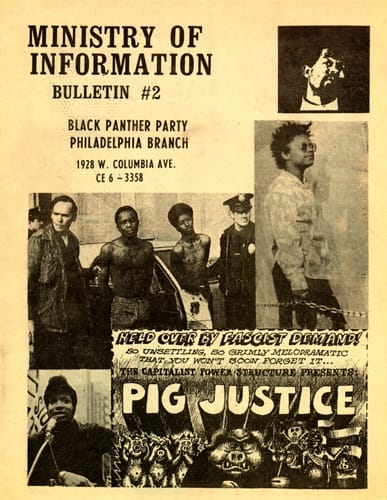
Except, as he points out, that’s not really true. There was a whole war about slavery. In Great Britain, suffragettes carried out an arson and bombing campaign. The Black Panthers and the Weather Underground were expressly (defensively) militant organizations. The Pan Africanist Congress was a nationalist splinter group of the African National Congress.
Malm leans into the radical flank effect, a term introduced by feminist writer and political scientist Jo Freeman. She described it in terms of varying levels of extremism in feminist groups of the 60s and 70s.
Their acceptability was increased by those groups labeled radical or revolutionary and ridiculed by the media. The latter groups provided a ‘radical flank’ against which other feminist organizations and individuals could appear respectable. Without the more flamboyant and/or extremist groups, organizations like NOW and WEAL would have been open to being dismissed as too far out.
How to Blow Up a Pipeline is a meditation on climate activism and the required and justified existential shift from protest to resistance.
The remaining question is whether it is possible to locate even one minimally relevant analogue to the climate struggle that has not contained some violence. Strategic pacifism is sanitised history, bereft of realistic appraisals of what has happened and what hasn’t, what has worked and what has gone wrong: it is a guide of scant use for a movement with mighty obstacles. The insistence on sweeping militancy under the rug of civility – now dominant not only in the climate movement, but in most Anglo-American thinking and theorising about social movements – is itself a symptom of … the demise of revolutionary politics. It barely exists any longer as a living praxis in powerful movements or as a foil against which their demands can be set. … Since the 1980s it has been defamed, antiquated, unlearned and turned unreal. With the consequent deskilling of movements comes the reluctance to recognise revolutionary violence as an integral component.
The question is why these things don’t happen
This week, the Trump administration is (again) floating the idea of the US government owning a stake in AI companies. Trump likes to do this — it happened with Intel and it’s happening with mining company USA Rare Earth. And while it might look like Comrade Trump’s first steps into socialism, the limited and specific industries are extremely telling. These investments are wagers where the US government is pumping money into industries that will make a very few people exceptionally wealthy.

Just a couple days ago, Elon Musk became the world’s first trillionaire on the back of the SpaceX IPO, the obscene valuation of which was driven, in part, by Musk’s plans to put AI data centers in orbit. Meanwhile, OpenAI and Anthropic are also going public this year — OpenAI is shooting for a $1 trillion valuation. It’s expected that the AI industry will spend $1 trillion just building data centers in the next year or so.

In April of this year, a man threw a Molotov cocktail at OpenAI CEO Sam Altman’s house. That man was arrested shortly after while trying to break into OpenAI’s headquarters. In response, Sam Altman posted a picture of his infant human shield and called for deescalating the debate around AI.
In September 2025, Michigan’s Saline Township’s board voted 4-1 to deny rezoning about 600 acres of land from agricultural use to industrial research use. The local residents and the township board did not want a data center built on the Saline River and this vote proved it.
The company seeking to build said data center in Michigan, Texas-based Related Digital, sued the town, saying the decision was an “arbitrary refusal to permit a legitimate and economically feasible land use” and that building the data center is “appropriate, necessary, and reasonable.” Saline Township, population 2,375, realized it didn’t have the resources to fight Related Digital in court and settled in December.

A couple weeks ago, Michigan governor Gretchen Whitmer, Oracle CEO Clay Magouyrk, and OpenAI CEO Sam Altman (among others) were all at the groundbreaking ceremony. Whitmer assured Michigan residents that their electricity bill would not go up as a result of the data center. Magouyrk insisted that the new “closed-loop” cooling system would use less water than farming the land would. Sam Altman, who people consistently describe as a “pathological liar,” said:
This could very well turn into the site where cancer gets cured. This could turn into the site where hundreds of millions of students around the world learn and get private tutoring. This could turn into the site where millions of small businesses would run their business in the cloud. A gigawatt of AI can do all those things.
Here is Virginia State Representative Suhas Subramanyam, who serves an area with more data centers than any other representative, explaining to Secretary of Energy Chris Wright that data centers do not, in fact, bring down electricity prices.
Here’s a press release from a water-monitoring company about how, while closed loop systems use less water, they also use more chemicals that get released into the water table. And, apparently, they end up using more electricity.
I’m not even going to link anything about Altman’s statement because he didn’t actually say anything in that quote. Sure, it could become all of that. It also could be converted into a unicorn preserve.
One cannot treat a data center cruelly

Jodie Foster’s character (with her inexplicable accent) in Elysium, Defense Secretary Delacourt, is extremely worried about all of the illegal immigrants from Earth crashing onto Elysium. In the opening minutes of the movie, she resorts to murdering refugees to prevent unauthorized ships from landing. When her position is threatened, she turns to the CEO of a defense contractor to help her do a coup.
Communist theorist R. Palme Dutt had a lot to say about the overlaps between capitalism and fascism.
Fascism is in short nothing but a ragbag of borrowings from every source to cover the realities and practice of modern monopolist capitalism in the period of crisis and of extreme class-war. There is not a single creative idea … The reality of Fascism is the violent attempt of decaying capitalism to defeat the proletarian revolution and forcibly arrest the growing contradictions of its whole development.
People don’t want AI. People don’t want data centers. A tiny handful of the world’s richest individuals do. And they’re making it everyone’s problem by involving the government. AI companies collectively have already spent almost $200 million in donations to candidates in this year’s midterm elections. Law enforcement calls anti-tech violent extremism a kind of terrorism.

Writer and lecturer R.H. Lossin has this to say about sabotage in just such an environment:
Sabotage can be read as a defensive move against the literal and metaphorical apparatus of … control as well as a sort of prefigurative, if temporary, seizure of property. It is both a logical, justifiable and effective form of resistance and a direct affront to the sanctity of capitalist ownership.
The major thrust of How to Blow Up a Pipeline is that, in the face of unsurvivable climate collapse driven by capitalism, sabotage and direct, violent action is not only (morally) justified, it’s necessary.
We must accept that property destruction is violence, insofar as it intentionally exerts physical force to inflict injury on a thing owned by someone who does not want it to happen … But in the very same breath, we must insist on it being different in kind from the violence that hits a human (or an animal) in the face, for the reasons just specified: one cannot treat a car cruelly or make it cry.
Property does not stand above the earth; there is no technical or natural or divine law that makes it inviolable in this emergency. If states cannot on their own initiative open up the fences, others will have to do it for them. Or property will cost us the earth.
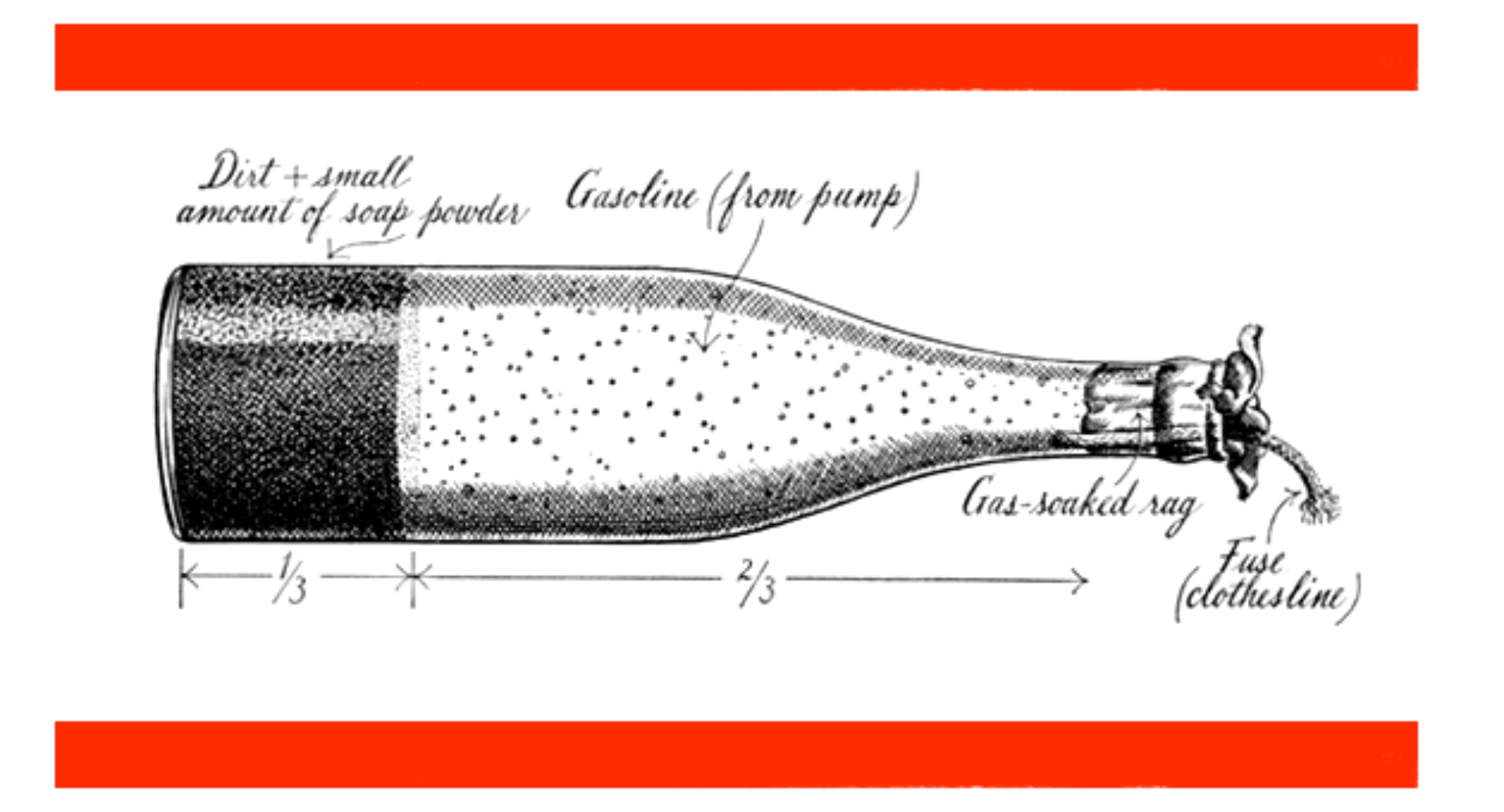
This isn’t the part where I point out that Meta has started building its data centers in “rapid deployment structures” that are just a step above tents. And this isn’t the part where I point out that, in 1967, The New York Review of Books had an instructional diagram of how to make a Molotov cocktail on its cover.
This is instead, in the context of (and under the pretext that) this is still a cyberpunk series, the part where I remind you that Max Da Costa — violent ex-con, thief, illegal immigrant, and murderer — is the hero of Elysium and saved untold lives through his actions. Failing at passivity and reacting violently to oppression is not a moral failing. Standing up for yourself — standing up for humanity — especially in the face of an existential threat is not a character flaw. And property is never as important as people. Even if — and especially if — profit is involved.
And anyone who says otherwise is trying to exploit you.
Whatever the black hells of suffering and destruction that have still to be passed through, we face the future with the certainty and confidence of approaching power, with contempt for the barbarous antics of the doomed and decaying parasite-class enemy and its final misshapen progeny of Fascism, with singing hearts and glowing confidence in the future.