


Key Your Debt is a whimsical, painful, indie roguelike
Key Your Debt offers you the chance to experience being debt-free ... at a price
How does it feel to be debt-free? It’s a question most of us will never answer. With Key Your Debt, however, a whimsical, key-mashing roguelike, developer An Odd Cloud offers players a fleeting whiff of that particular aspiration in a game that may become your next obsession (or cause repetitive strain injury). Either way, Key Your Debt isn’t giving that feeling up without a fight.
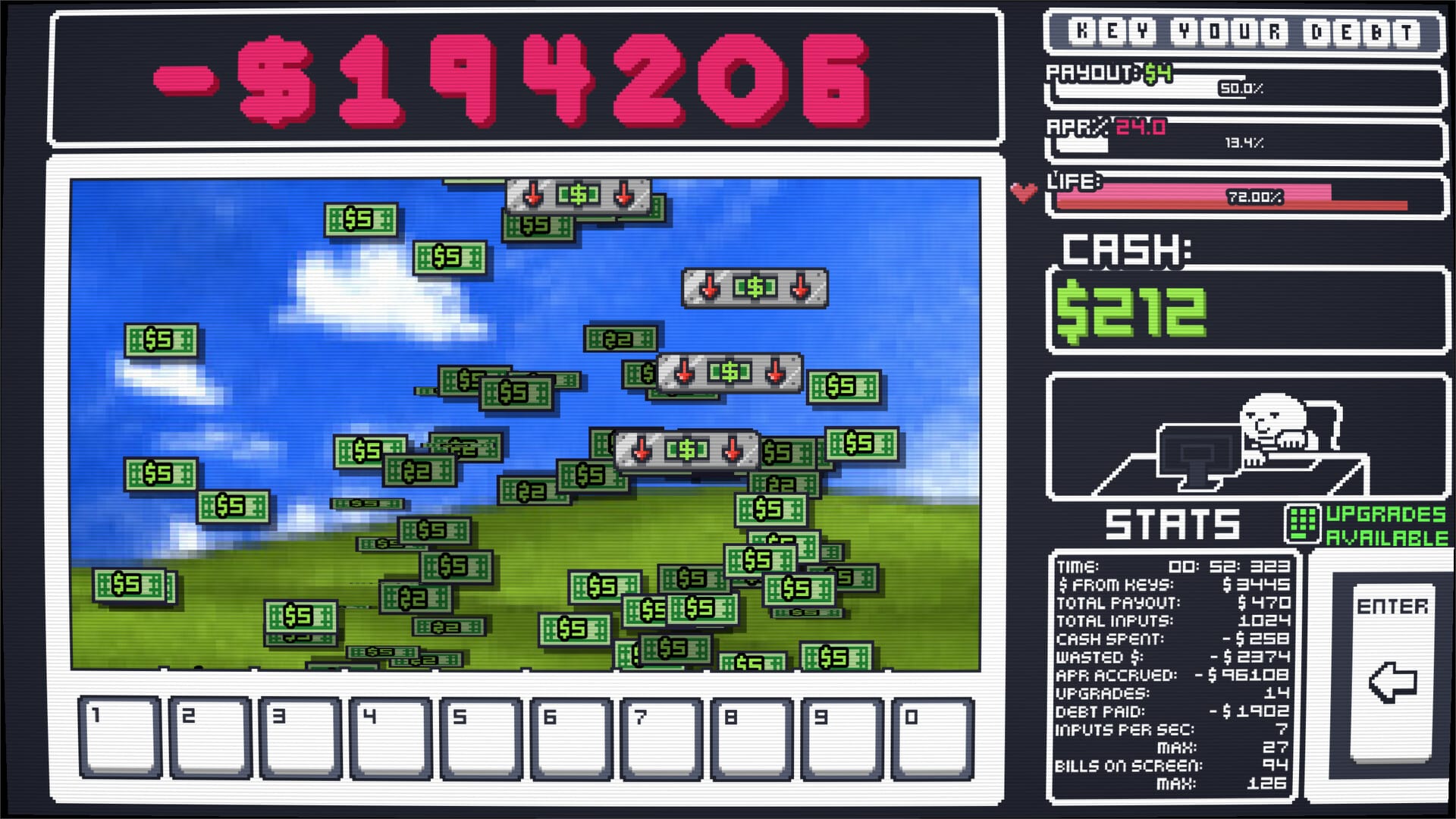
Key Your Debt actively tells you “no” if you so much as click your mouse, instead you’re tasked with frantic mashing of your number keys in order to pay off crushing debt before you die. That mashing fires banknotes in random directions across the screen. Some will float above and momentarily slow the large number denoting the financial hole you’re in. Most will bounce off obstacles that move across the screen and plummet into the shadows; money wasted.
Those number keys also fill a meter to the right of this screen, which pays out a small amount when full. Another below it shows your APR, which will increase your debt by a set percentage with each completion. The last is more important: decreasing as your life ebbs away. So far, so true to life. What you’ll immediately notice is how rapidly these latter meters move and how little money you receive to mitigate their progress.
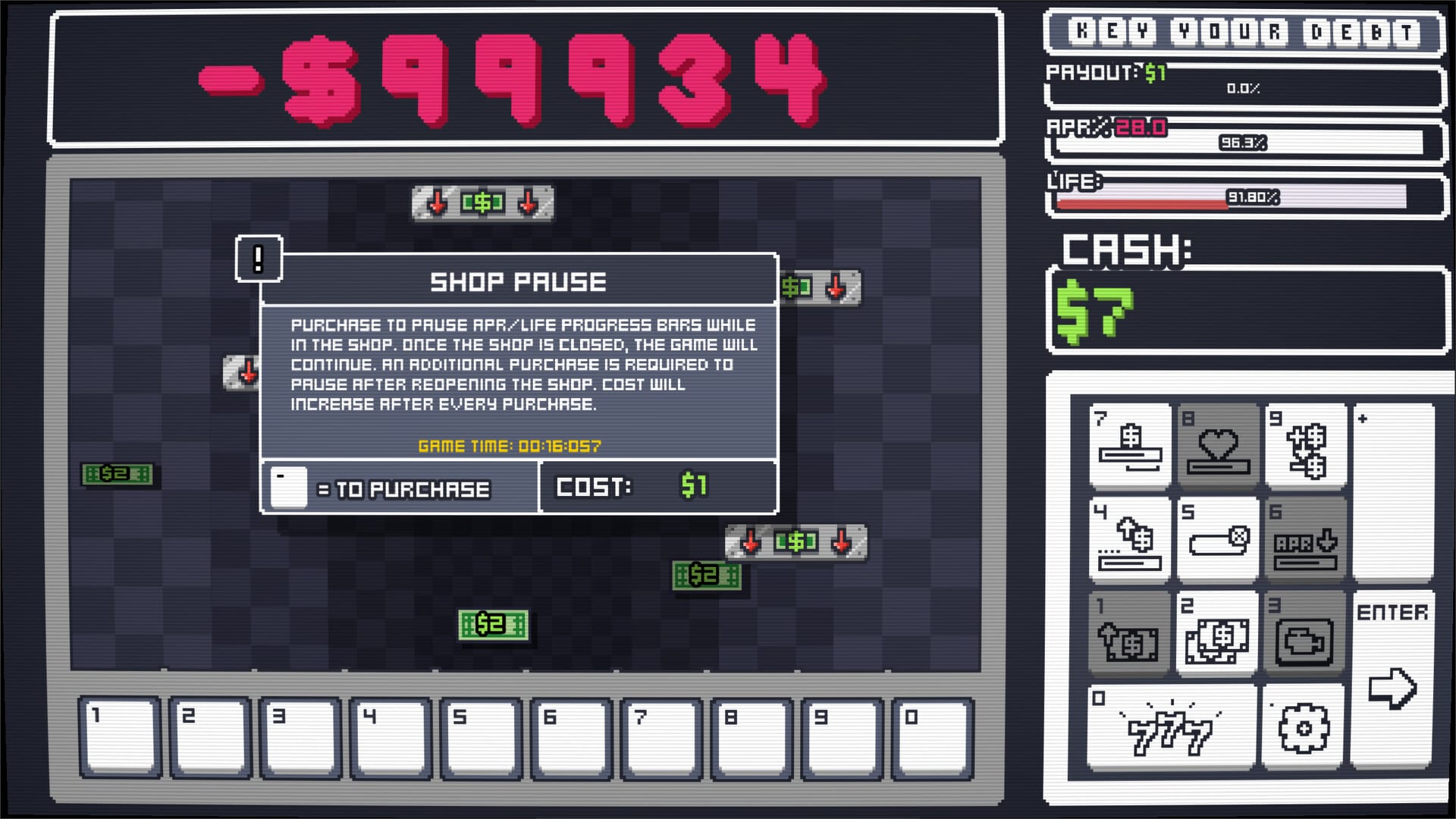
Hitting return, however, offers a range of upgrades (corresponding to your keypad) including removing obstacles, reducing APR, and even slowing down your inevitable crawl towards death. The earliest of these cost a dollar. Later, they’ll set you back as much as $50,000.
This is much of the challenge of Key Your Debt: learning these upgrades’ positions and how to prioritise them. Do you focus on reducing how much further debt you accrue, increase the money you can throw at it, or prolong your life? You have to be careful with prevaricating over those upgrades. Time does not halt when you open the menu. Your ability to parse these upgrades and how quickly—and accurately—you can key in purchasing upgrades is what decides whether or not you succeed. While you can purchase menu pauses, doing so may well push you below the threshold for an upgrade. How you combine upgrades is up to you and the most helpful sequences may surprise you. But there is a right answer.
That limits the scope of Key Your Debt compared to similar roguelike games, but this is in its favor. It’s a game to dip in and out of. And you will want to put this game down. Its short, sharp rounds lend Key Your Debt to the same obsessive play that defined Balatro and Blue Prince for many, but the physical toll of its gameplay favors consuming it in bitesize chunks. For someone like me, with increasingly short pockets of time in which to play, that’s ideal. Others given to hours of play may want to use Key Your Debt as seasoning for longer sessions — a point-of-difference between other games.
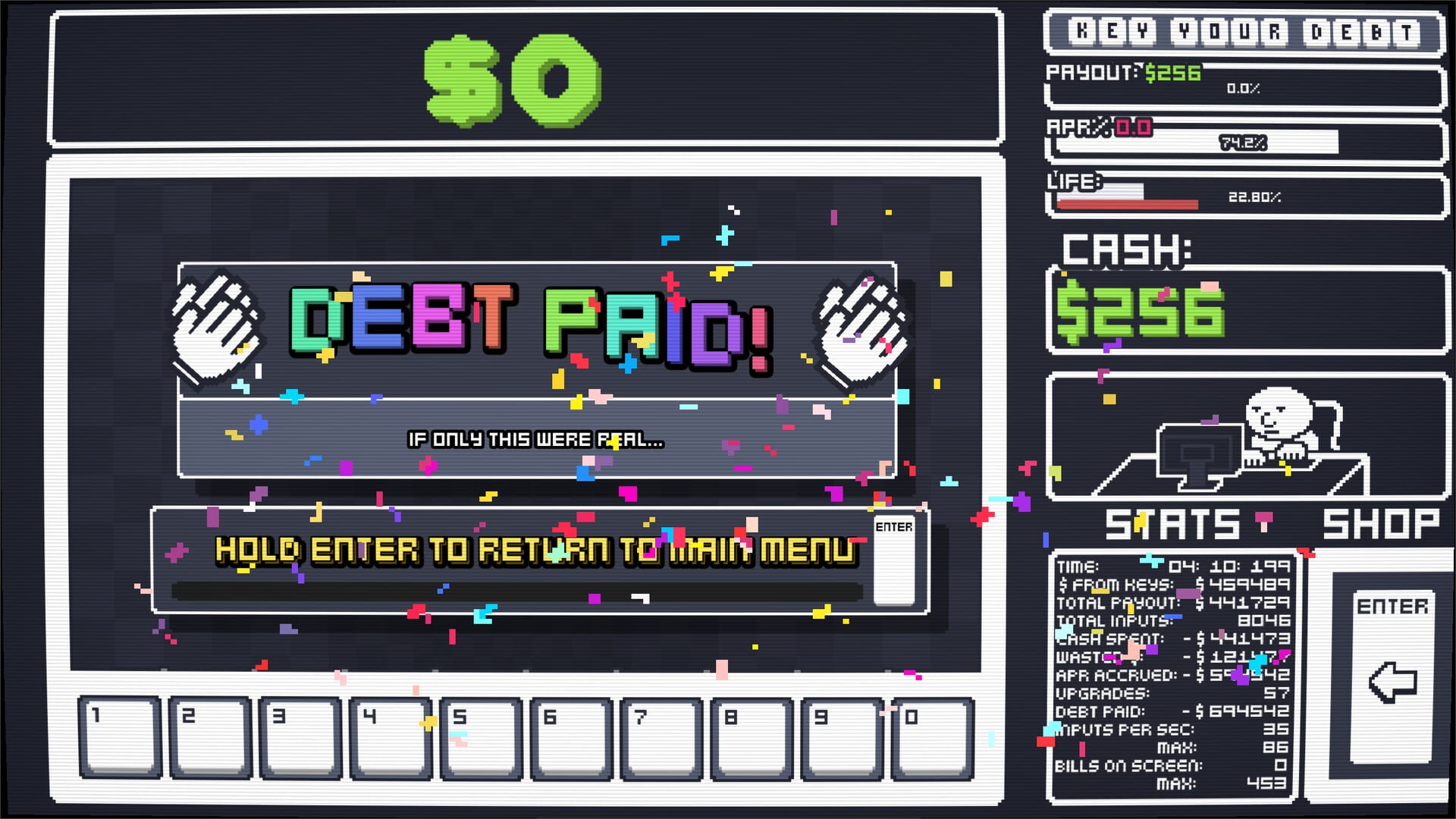
Being a roguelike, Key Your Debt is also frustrating. When that’s in the player’s control, it’s a motivator. You’re liable to forget where upgrades are or miss keys in your haste—I often found myself not buying an upgrade and having to re-enter the menu with more deliberate key presses — but you can get better. It’s also easy, however, to trap yourself in a loop of menu navigation if you don’t return to gameplay cleanly, since its driven by using the same keys for everything, and accidentally toggle music and sound effects. An accidental click of the “beans” key, however, is always a joy.
Though failure is part of this style of game, those you experience in “classic” mode can be compounded by the physical mashing of keys; coming away from a run with mistakes that feel unfair and sore wrists makes that failure loop harder to bear. One can see why “easy” mode exists. It is far more forgiving—maybe too forgiving—and perhaps where players should start to get to grips with what the game demands. Though, “classic” mode may need further tweaks to achieve the most satisfying balance between frustration and success.
All of the above should make it clear that Key Your Debt is not an accessible game. That said, it does offer an option to toggle its CRT visual effect and that does suggest An Odd Cloud is considering and reacting to accessibility feedback. That bodes well for future games. Which is perhaps the most important factor as all of the above is couched in this being the first release from a solo developer. Something that only makes it more impressive that, outside of a few issues one may even expect from more-resourced projects, Key Your Debt is already a well-rounded and persistently re-engaging experience.
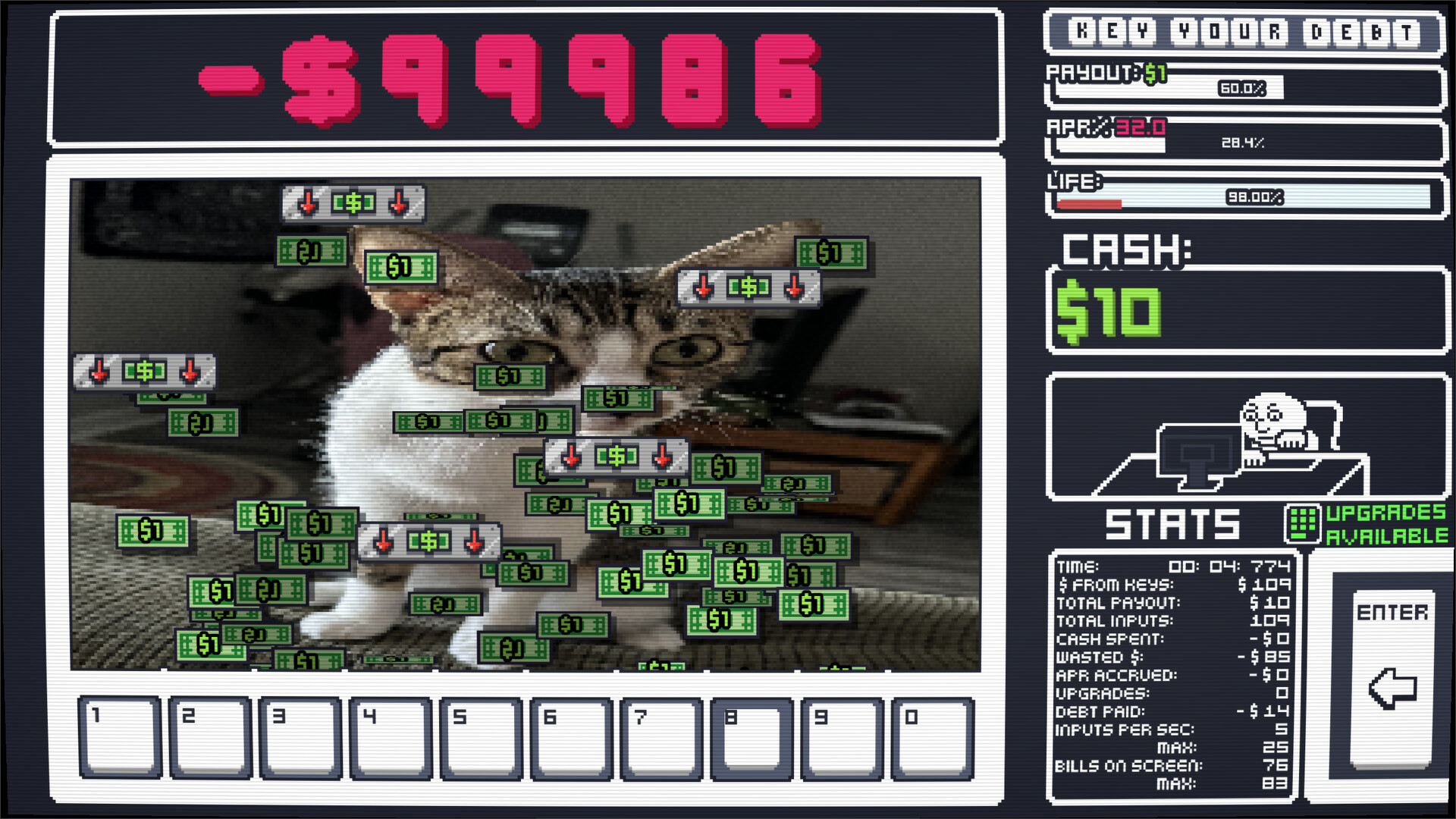
Key Your Debt is not a sophisticated game. The systems are not complex once learned and there is a finite level of replayability in its loop. But what is there is a fun and refreshingly fleeting roguelike experience that offers a whimsical analog for watching your life melt away as you struggle against the economic tides of, well, everything — and the carpal tunnel that comes with it. One that not only keeps pace with more accomplished roguelikes, but, more importantly, is a signal that An Odd Cloud is one to watch going forward.