


Labyrinth of Touhou Tri is a dungeon crawler for freaks
Labyrinth of Touhou Tri asks a lot from a very specific audience


Every dungeon crawler might look the same on the surface. But they all have distinct flavors: Etrian Odyssey’s party synergies, Dungeon Encounters’s math puzzles, Shin Megami Tensei’s oppressive atmosphere. By their nature, these games cannot suit all tastes. The common rat that steals all your gold in Dungeon Encounters, for instance, is either a hilarious joke or an unforgivable crime that makes you throw your $300 Nintendo Switch in the garbage. Most people in the world are surely in the latter camp. Yet the remainder love Dungeon Encounters more than anything else. They understand that difficulty isn’t just a matter of accessibility — it’s about catering to specific needs.

Labyrinth of Touhou Tri -The Dreaming Girls & The Mysterious Orbs- is one such experience. The player builds a party of 12 characters out of 48 (borrowed from the long-running Touhou series of independent games, set in a closed world where mythological spirits throw drinking parties and/or challenge each other to laser duels depending on the mood) to explore various dungeons and defeat enemies. Battles are turn based, where turns are determined by speed and the recovery time of each move. You can swap characters between your four-person frontline and the reserve at any time; in fact, you’re encouraged to, because characters in reserve quickly recover HP and MP. Some party members become stronger the longer they remain in the fray, while others will crumble if you don’t swap them out before they take damage.
The heart of the game are the boss fights, which are brutal. The very first of these encounters will demolish you if you don’t pay close attention to the opponent’s strengths and weaknesses as well as your own party composition. Later bosses summon helpers that buff their stats sky-high, inflict your party with ailments that activate their own super attacks, and have conditional effects that limit the amount of damage they can take between turns. Worse, higher difficulty levels forbid the player from outleveling them.
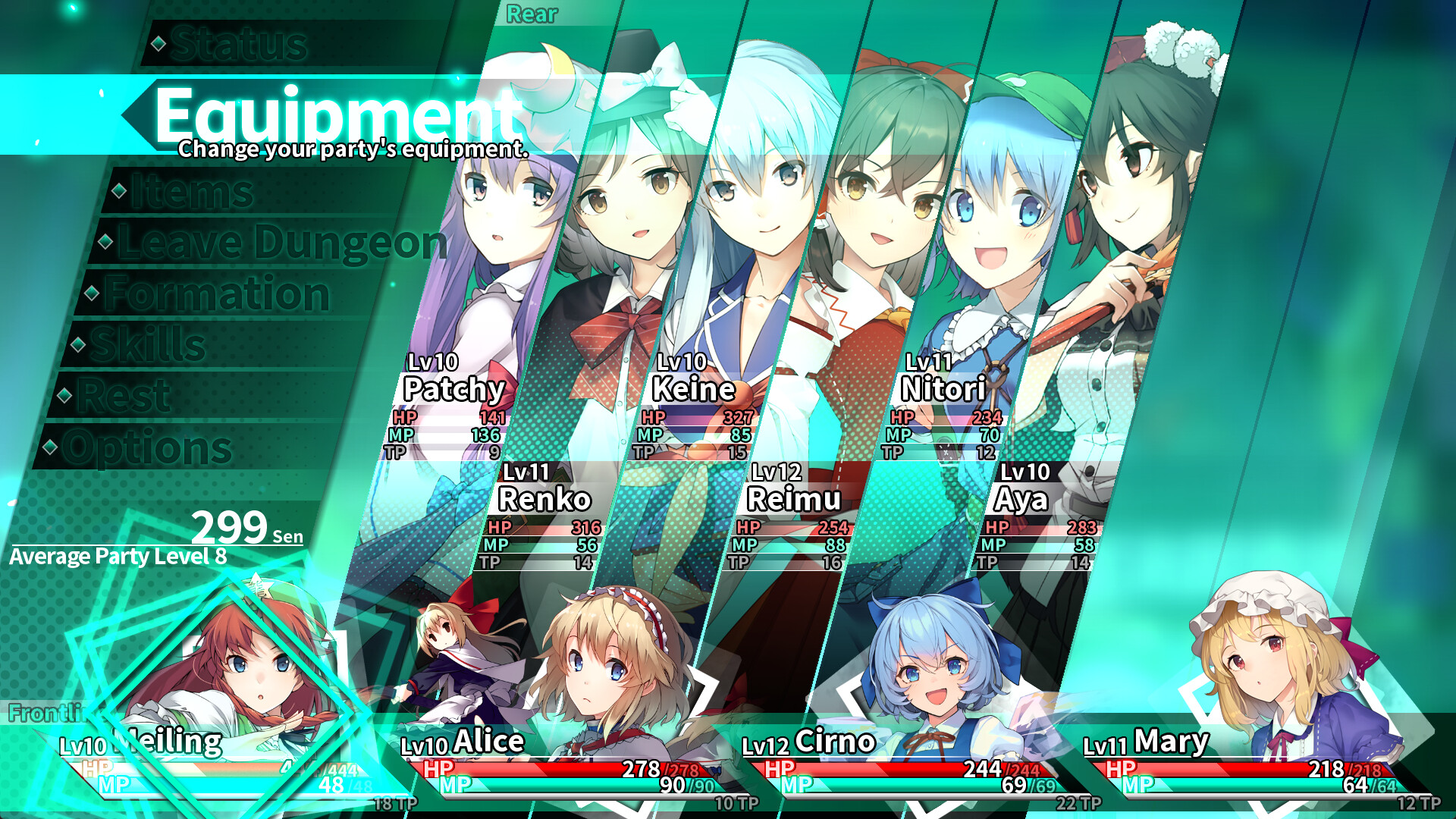
There are plenty of ways to tip the scales, though. Upgrading individual pieces of equipment, for instance, powers up every single kind of that equipment you find in the future. A character’s skill points can be reassigned in the field at any time. Bosses come with charts breaking down their strengths, weaknesses, and even the order in which they use certain moves. You always have what you need to succeed. All that remains is crafting your 12 person party into a key that can open the correct lock.
Labyrinth of Touhou Tri’s identity isn’t just a matter of what it is, but what it chooses to leave out. Unlike its predecessor LABYRINTH OF TOUHOU - GENSOKYO AND THE HEAVEN-PIERCING TREE, the player cannot patch a character’s inherent weaknesses with subclasses. Resource management outside of battle is a total non-issue, which is a bummer for folks who enjoy the stress of escaping a Wizardry dungeon while low on health, items and allies. The enemies you encounter in the field are also much weaker than the bosses, without enemies equivalent to Etrian Odyssey’s FOEs or even the thieving rats in Dungeon Encounters.
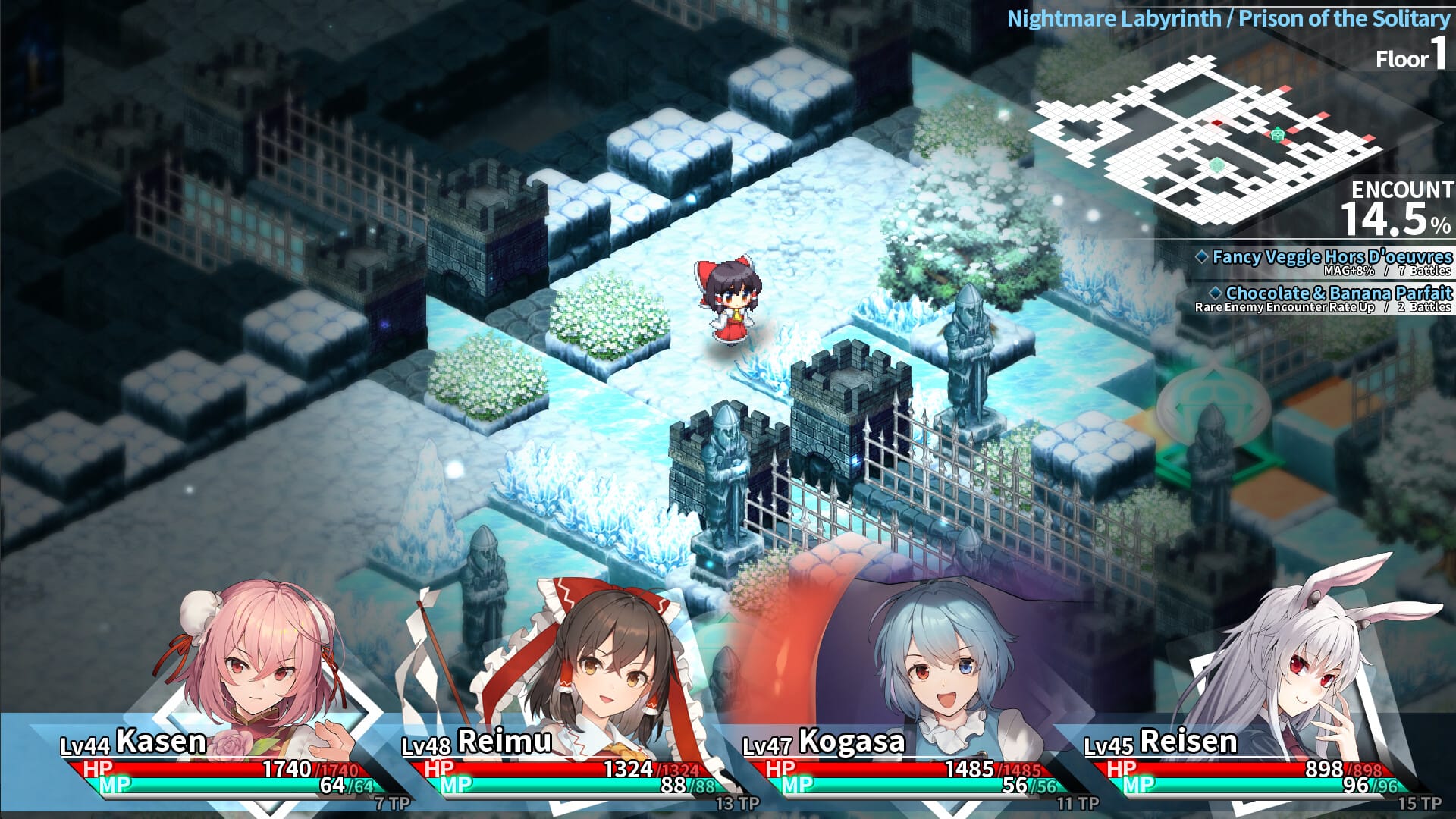
The game’s emphasis on puzzle battles over environmental exploration isn’t always to my taste. That said, this game does find means of injecting life into the dungeon itself. My personal favorite are the variety of ways enemies interact with you and each other during combat. For instance, a Fairytale Man-Eating Wolf will eat a Fairytale Red Riding Hood if they share the stage in battle. Let enough time pass, and the Red Riding Hood morphs into a powerful Fable Assassin Girl, erupting out of the Wolf’s stomach for a much stiffer challenge. The player is encouraged to game these interactions to earn as many resources for themselves as possible. To me, though, what matters most is how they grant dungeons and their inhabitants the illusion of life outside of cold numbers and attack patterns. This is what original Etrian Odyssey director Kazuya Niinou once called the power “to create dramatic and fun situations in your own minds.”
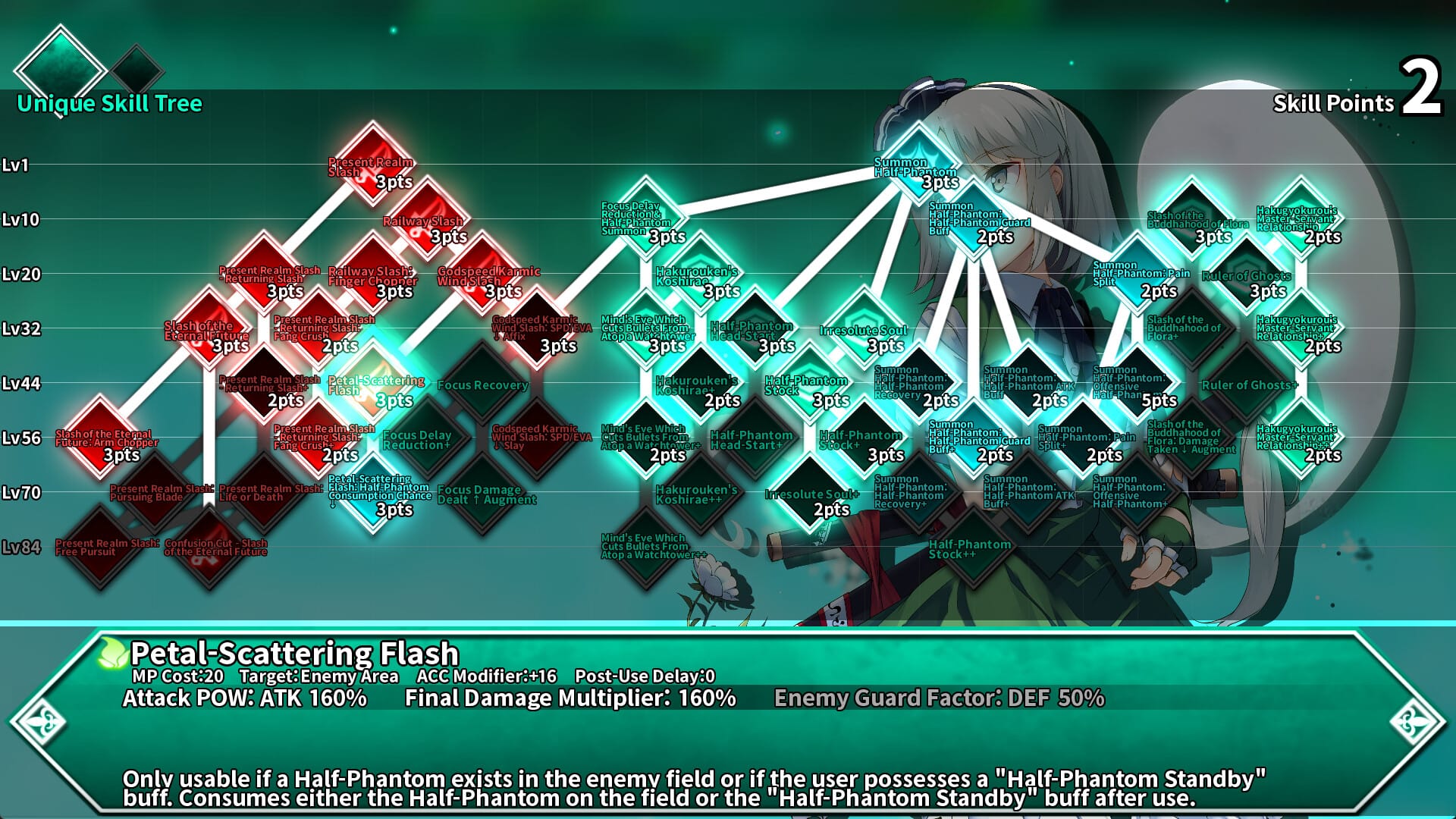
The specificity of each character’s use in combat also does a lot to convey their particular personalities. Aya the tengu journalist weaponizes her impatience to give party members extra turns. Cirno the ice fairy’s “Try, Try Again” ability keeps her stubbornly in the fray even when your brawnier party members are ready to return home. Renko and Mary are ordinary humans with hidden potential; while Renko is a powerful support character, she takes longer to come into her own, and her anxiety in the story is paralleled by the slower rate at which her abilities unlock. While Labyrinth of Touhou Tri is not as smooth an introduction to Touhou as the recent Fantasy Maiden Wars, which introduces every character as if you’ve never met them before, it does at least capture the appeal of the setting–even if the game’s sprawling script can feel excessive at times for a dungeon crawler.
Also worth noting is the game’s use of generative AI. The Steam page notes that “this game utilizes AI for the creation, editing, and upscaling of some graphics such as backgrounds and icons.” A post on X from the translator clarified just before release that “all AI-genned assets have been replaced barring a very small (I believe 2?) set of screen effects he couldn't find suitable replacements for.” Even though the developer 3peso pivoted away from the technology later in production, it still casts a shadow over the game that has led some folks to avoid it entirely.
The game’s entire identity, in fact, has been in flux over the past few weeks. 3peso was cowed enough by Steam reviews criticizing gimmicks in later dungeons that they removed the majority of them from the game. Which, of course, led to criticism from players who enjoyed those gimmicks and thought that cutting them ruined the game’s texture. 3peso finally restored them in a recent patch. “I've decided that since I'll probably receive criticism whether they're present or not,” they said, “at the very least, I would prefer to go with the choice I think is more interesting.”
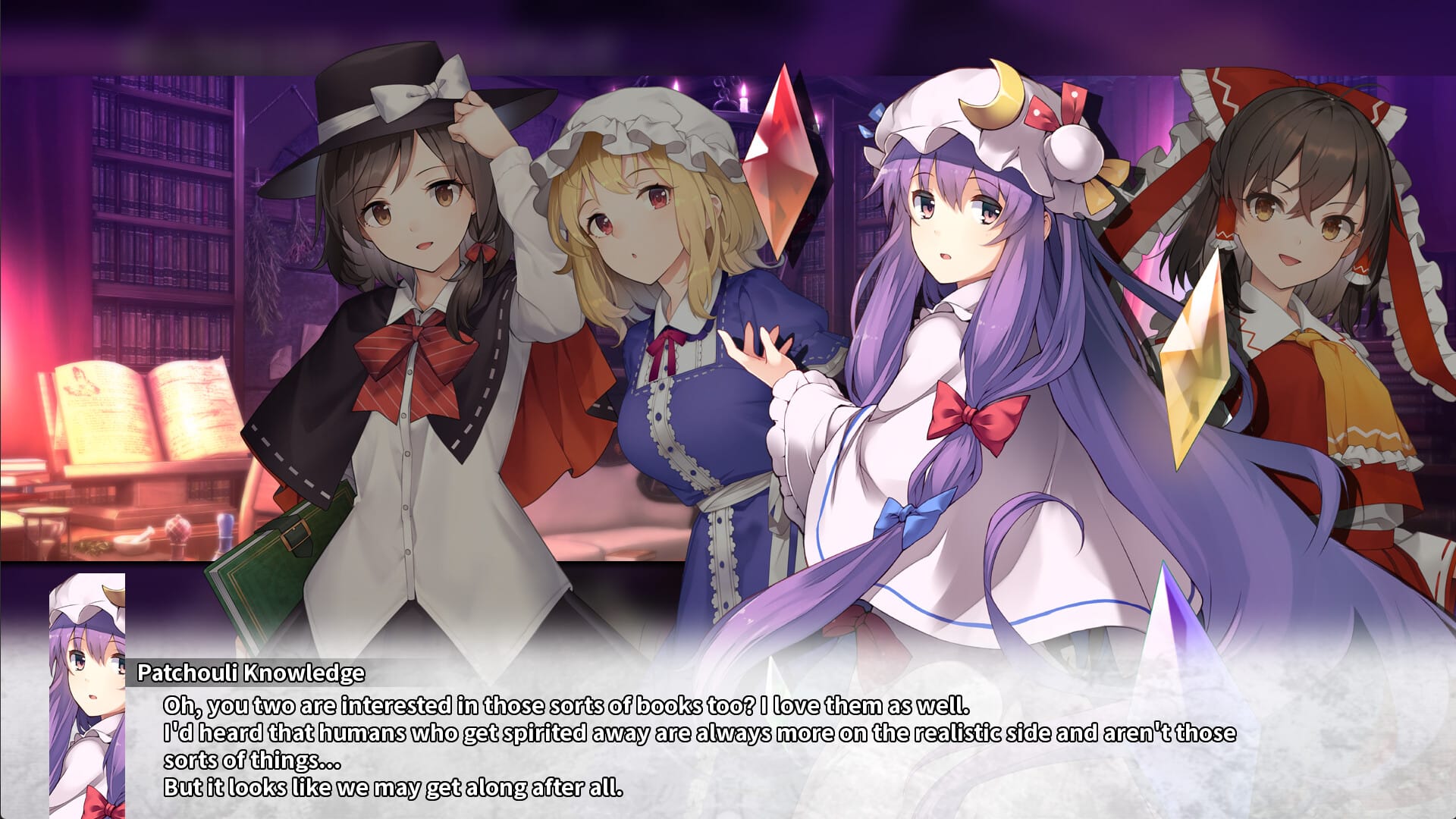
Art is communication. Despite Labyrinth of Touhou Tri’s acknowledged use of generative AI early in development, it engages earnestly in this pursuit. 3peso smooths out aspects from earlier games, like letting you re-equip your party after a failed boss battle before returning to the fray. In other spots they double down on friction, by making healing much harder to come by for instance. You can see them choosing what parts of their earlier projects meant the most to them, and doubling down on those parts rather than shying away.
Labyrinth of Touhou Tri requires so much from the player: the willingness to play a Touhou game, the genre knowledge to parse grueling boss encounters and the stamina to redo a fight over and over until they execute their strategy perfectly. It is a key that will only fit a certain lock. But it’s not a bad thing to be specific. Specific art makes memories, especially when it finds the right person at the right time. You might spend the rest of your life pursuing a taste, or a smell, or a game that you played one day.
Most games made today will not be financially successful. The industry is littered with the corpses of projects that aimed for mass audiences and failed. As the years go by, though, I become increasingly convinced that people who play games are not part of any one “mass audience.” Instead they form individual subcultures chasing specific textures and feelings. Labyrinth of Touhou Tri is one such game, with what you could call a very particular mouthfeel. For me that’s a strength rather than a weakness. Why should all games aim for general appeal? An industry that embraced personal taste and encouraged curiosity would be an industry worth defending.