


Epic CEO Tim Sweeney doesn't understand AI backlash, classic literature
AI disclosures are *not* like The Scarlet Letter


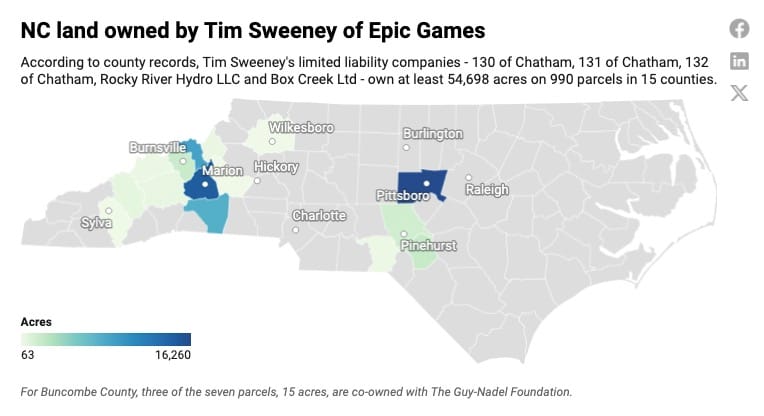
Let me start by saying this: Epic CEO Tim Sweeney has done a lot for the conservation of North Carolina lands. He owns (or owned as of 2025) roughly 55,000 acres of NC and regularly donates or sells parts of it to the government or conservation agencies.
His net worth of somewhere north of $5 billion means he can do that. That's a nice thing he's doing.
So anyway, after laying off 1,000 people a few months ago and then making an incredibly tone deaf statement about it, Tim Sweeney was at Unreal Fest in Chicago last week. There, Tim talked up Unreal Engine 6, its AI integration, and his plans for the future of gaming. After that, he sat down with PC Gamer for an interview.
The interview is a fascinating read not for the content, but for Tim's plug-your-ears-and-say-la-la-la answers. I'm not going to go into most of it because Tim's vision of the future of gaming — you're not going to believe this — is basically Fortnite, the Epic Games Store, and Unreal Engine.
This quote here sums up his attitude really well:
Imagine being a startup which has 100 people … and you have to launch a game that can appeal to a gamer audience that also has Fortnite available.
Imagine it! Imagine making a game that won't be as popular as Fortnite! Imagine making a game that isn't Fortnite at all! Have you ever imagined something so absurd!? Why would anyone play anything that isn't Fortnite when Fortnite is right there!?
So you can kind of see Tim's relationship with creative pursuits from that quote. That carries over into Unreal Engine 6, which combines Unreal Engine and the Unreal Editor for Fortnite into one package (whee). UE6 will also integrate AI into the engine itself. From their announcement:
We’re building development pipeline features such as an MCP [Model Context Protocol] with integrations for Claude, Gemini, and others, as creativity and productivity multipliers so that teams can focus their efforts on the essential creative and technical tasks of development rather than time on time-consuming manual tasks.
Tim clarifies what those time-consuming tasks are in the interview.
You build out a rough 3D model, you start texturing it, and then if you like the shape of it, you would go in and add a lot of detail in the 3D modeling phase, and then refine the texture. And you'd have a really elaborate creation process, and then you'd hand it off to a rigger who would do a whole lot of rigging work, and you'd spend an enormous amount of time creating an art asset.
Only a fraction of that time is the artist really injecting the creativity. A lot of it is just drudge work of moving polygons and vertices around to make the thing work.
He repeats that idea that a lot of creative work is "drudge work" in the next sentence.

Tim spends a lot this part of the interview refusing to understand what it is about AI that people reject. It's clear that, to Tim, AI is merely a tool and there's obviously nothing wrong with tools.
He goes on to equate generative AI with artists using reference materials and doubles down on those productivity improvements.
I think it's impossible to reconcile the idea that developers shouldn't use productivity-improving tools with the state of the industry … We've got to find greater means of efficiency.
For Epic Games, remember, greater efficiency came at the cost of 25% of its workforce. This was "incredibly painful" for Tim.

When the interviewer suggests the thing about AI people have a problem with is that all LLMs are built from stolen creative works, Tim mostly ignores it. He acknowledges that many AI companies had (not have, had) "shitty practices," but think of the productivity.
If it weren't for some AI companies ripping off people's content, I think we should be praising that as a tool for making it easier for people to create.
This is the part of Steam's AI disclosure requirements that Tim doesn't like. It prevents people from being maximally creative and profitable.
You have to get this Scarlet Letter of AI attached to your product, and now there is a hater community trying to kill the game.
Now, I'm not an expert in the works of Nathaniel Hawthorne. My experience with The Scarlet Letter is having to read it in high school mumblety years ago and a half-remembered viewing of Easy A starring Emma Stone while on a plane. But I'm pretty sure getting called out for making soulless AI slop is not the same as the draconian punishment of a puritanical society for a perceived sin.
And there's no doubt about the sin of LLMs and generative AI. It's theft. The training data was stolen. Some of it was full-on illegal, all of it was indefensible. Tim recognizes this, he just doesn't care. He doesn't care because he sees creativity as "drudge work" and he doesn't like getting called out for cheating his way though the process.
Tim. Timmy. Timothee. AI disclosures aren't ascribed guilt. They're admissions. They're disclosures. And people choosing not to participate isn't "a hater community trying to kill the game." It's consumers making an informed decision about what they're willing to be complicit in.